
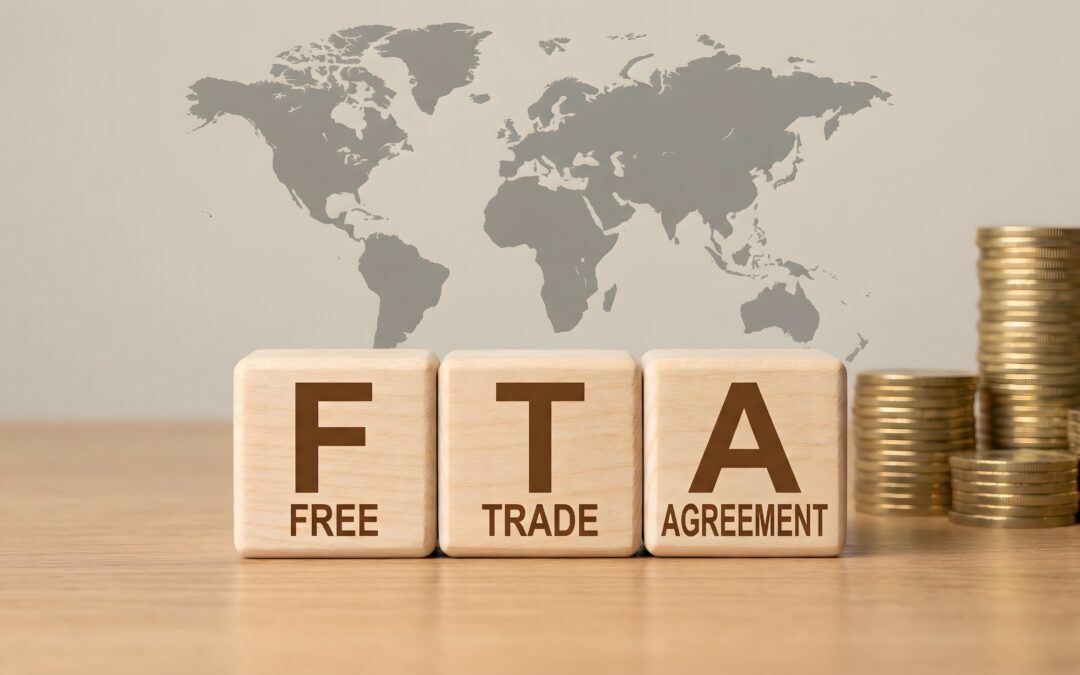
What is a Free Trade Agreement (FTA) and how might it help New Zealand and companies like Scriptus Publications?
Scriptus is an education company whose flagship offering is the online course Learn Business English, from which many people can benefit.
An FTA is an agreement to form a free-trade area between cooperating states, according to an explanation on Wikipedia. It says that there are two types of trade agreements: bilateral and multilateral.
“Bilateral trade agreements occur when two countries agree to loosen trade restrictions between the two of them, generally to expand business opportunities.
Multilateral trade agreements are agreements among three or more countries and are the most difficult to negotiate and gain agreement”, according to the online encyclopedia.
The Debate Around Bilateral FTAs
From my knowledge, primarily as a financial journalist and sometimes as an economic adviser in the New Zealand Treasury years ago, of working on trade policy, the benefit of bilateral FTAs is debatable.
Interviewing Mike Moore, (who was then director-general of the World Trade Organisation (WTO) (he had this role from 1999-2002) in Dubai, UAE, where I was then living and working as a financial journalist at Khaleej Times, a newspaper,), he was adamant that bilateral FTAs only divert trade, and do not necessarily benefit the consumer.
Contradicting this argument is a comment from a paper on the Australian Embassy website entitled “An Australia-USA Free Trade Agreement: Issues and Implications,” where it says that the “trade diversion” is a “traditional” argument about bilateral trade agreements, but this is wrong. Bilateral trade agreements often lead to multilateral trade agreements benefiting everyone.
The paper says: “The principal point of Free Trade Agreements is to secure trade liberalisation. While the traditional debate about FTAs is the danger that they can divert rather than create trade, the record to date suggests there has been little diversion and that FTAs and regional agreements have been effective in encouraging wider trade liberalisation”.
The New Zealand–India Free Trade Agreement
The most recent FTA in New Zealand was signed with India; the deal was concluded on 22 December 2025. It has received a mixed response. The leader of the NZ First party, Winston Peters, has said the agreement is terrible. Other parties and commentators say the opposite.
The deal’s aim is to expand the market for New Zealand exports. India currently ranks as New Zealand’s 12th largest goods and services export market, representing 1.5 percent of New Zealand’s exports with two-way trade accounting for NZD3.68 billion annually (year ended June 2025).
India is the fastest-growing G20 economy and by 2030, is expected to become the world’s third-largest economy (with GDP of USD7 trillion) and to have a middle class of more than 700 million, according to statistics released by the Ministry of Foreign Affairs and Trade (MFAT). “This leaves huge potential for growth not only for our premium food, beverage and consumer goods exports but also for tech and services exporters in sectors like gaming, education, tourism and fintech, ” the website says.
New Zealand exported NZD1.79 billion of goods and services to India, making India our 21st largest goods export market and 5th largest services export market. According to statistics released by the Ministry of Foreign Affairs and Trade (MFAT) New Zealand’s key exports to India in the year ending June 2025 were:
- Travel services (NZD 948 million)
- Industrial products (NZD 265 million)
- Forestry and forestry products (NZD134 million – Logs NZD77 million)
- Horticulture (NZD118 million – Apples NZD79 million and Kiwifruit NZD36 million)
- Dairy and Dairy products (NZD76 million – Albumins NZD62 million)
- Wool (NZD76 million).
Practical Challenges for Businesses
Although the idea is that this deal will expand export opportunities, we, at Scriptus Publications, do considerable work with India through our Learn Business English course, have not reaped any benefits from India, yet. Although we work in the education sector, we are finding it incredibly difficult to transfer Indian funds to New Zealand. It seems that there is a lot of discrimination in the banking sector. This will have to change if a FTA is to benefit traders in the longer term.